Kids are the Creative Boost this Industry Needs
Quick Take: The game industry requires more than just improved visuals, larger maps, or sequels. It requires young talent and more strange ideas, less preconceived notions, and the outright confidence to create games that might seem too wacky to work.
I teach game development to little kids, aged around 1st to 3rd grade.
And yes, it’s lots of fun…but there’s a lot I've noticed about the newer generation that should definitely be more addressed.
As a teen, I see myself as having both the inspiration to take game mechanics from other games, and real-world skills to make them true.
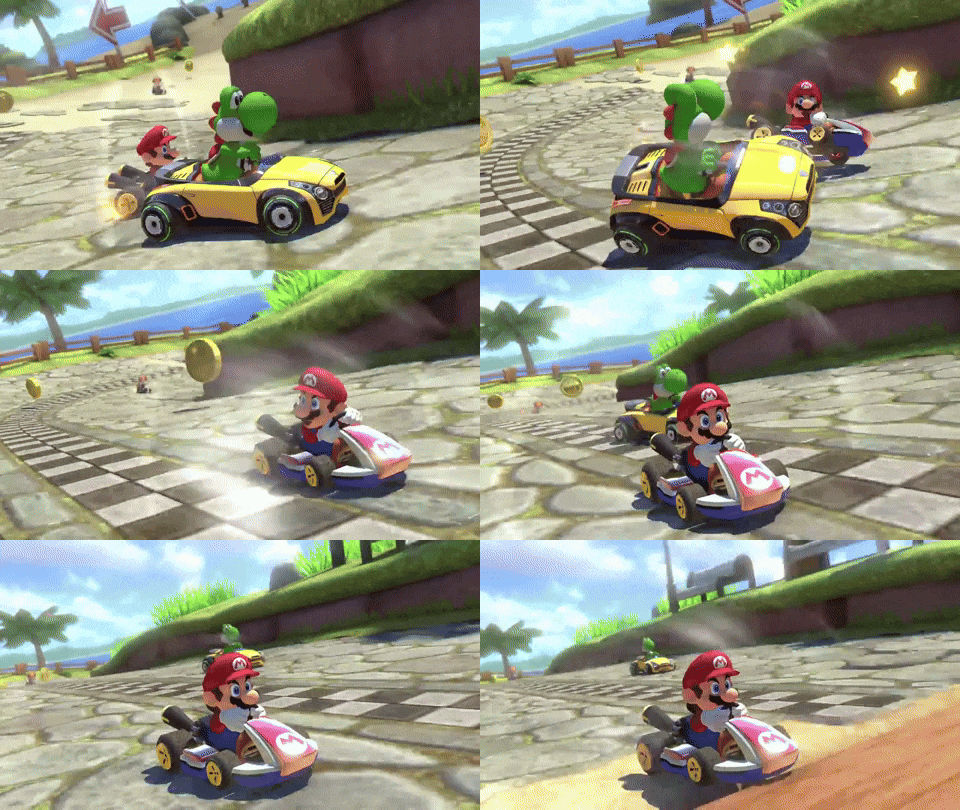
However, as I enable younger kids with the tools to make their own games, I’d think the games they’d make would be extremely similar to the FPS or maze runner games that I taught them. After all, they only had Geometry Dash or Mario Kart to draw inspiration from.
But when I hosted an afterschool Game Jam, the exact opposite occurred.
I was so wrong, in fact, one group of children planned to make a game where a character (a dot) had to jump on little animals to eliminate them, one by one, in a fixed amount of time. Suffice to say, they needed help learning to generate random animals under a fixed amount of time, but I found it inspiring to see that children were creating their own mechanics.
Once the jam was over, and the children were single-filedly walking from their desks back to their individual classes, I pulled one of the children in the group aside. I couldn’t help but ask: “where did you get the idea for your game from?”
The child smiled, and twirled her hair, grinning. “I just came up with it!”
To the kid, my question seemed hilarious. If her thoughts could speak, I’d bet they’d say something along the lines of, of course I thought it up, where else could it have come from?

(this was her guys)
The bounce-on-animal’s head game was one of many avant-garde games I got to see students making in the 1hr 30 minute Game Jam. Another group of kids made a game where you had to find a secret portal through a seemingly unsolvable maze game. Although that specific group took an idea I had already taught them (A maze runner game) they created a new game mechanic that made the game multi-dimensional and far more memorable.
This was very stunning to see: the same kids who diligently remained laser focused to my instructions, followed my lead, and participated so dedicatedly in my lessons…were coming up with their own game ideas so flawlessly! At first it was rewarding to see the students that I had been teaching for half a year grow as self-autonomous individuals, capable of thinking up and (for the most part) executing their ideas.
You might be thinking: “well of course: children are known to be more imaginative than we are.”
To that I say: of course, we all know that children are far more innovative than we are. However, there’s a thick border between childish daydreaming and thoughtful designing, and what I witnessed that day was real systems-thinking and problem solving in that group of 1st to 3rd graders.
I’m almost ashamed my first instinct was “they must have drawn inspiration from somewhere else.” To the children, it was only natural to create that interesting game mechanic.
As I reflect upon the process of problem-solving, sitting in my bed this Friday night, I was captivated by the brewing creativity in that Game Jam. Just for a brief second, an insanely profound thought whizzed past me.
We continue to treat our children like empty vessels that have to be filled with good content, good apps, good lessons, good templates, and good step-by-step instructions. Parents obsess over what our children are consuming, and I see it everyday, too. And we fight about screen time as if the screen is somehow a waste of time, deteriorating children's cognitive function like a helpless addiction, as if our children are just sitting around passively consuming whatever is fed to them.
But that isn’t the case!
The greatest threat to the gaming industry and the quality of games isn’t going to be AI, it’s going to be a lack of creativity.
We, as a society, are interrupting creativity before it can grow into a skill.
The little kids like I worked with a week ago have the potential to become leaders of new gaming frontiers.
But, therein lies the problem: our rigid, academically focused school systems and home life don’t allow kids to grow creativity till their innovative thoughts become beneficial. Instead of creatively stimulating lessons and learn-by-example schooling systems, children are condemned to rigid hierarchies dictated by pen and paper performance, gradually wearing down every whimsical, wide-eyed ounce of spirit in their body.